Where is the Priest?
Why does the New Testament call Jesus our great high priest? And why do we need him to be one? Most Christians have a fairly quick answer: We need a priest because we have sinned, and Jesus offered himself as the sacrifice for our sins. That is true, but there is more to the story.
This essay is adapted from the fifth message in The Meaning of Messiah, a series exploring Jesus through the eyes of the Hebrew Scriptures.
Jesus looks like a king. He is crucified beneath a royal title that says “King of the Jews.”
Jesus looks like a Torah teacher. He interprets Scripture, teaches in synagogues, and insists that he did not come to abolish the Torah.
Jesus looks like a shepherd. He seeks the lost, heals the wounded, feeds the hungry, and gathers the scattered.
But when does Jesus ever look like a priest?
He never offers a sacrifice in the temple. He never burns incense, enters the Holy Place, wears priestly garments, or serves at the altar. In fact, Jesus could not have served as an ordinary priest. He was from Judah, not Levi. He belonged to David’s house, not Aaron’s. The Torah does not authorize him to serve as a Levitical priest—and Jesus is not at liberty to disregard God’s Torah.
So why does the New Testament call him our great high priest? And why do we need him to be one?
Most Christians have a fairly quick answer: We need a priest because we have sinned, and Jesus offered himself as the sacrifice for our sins. That is true, but there is more to the story.
A priest does more than deal with past wrongs. A priest makes life in the presence of God possible.
Messiah’s priesthood explains how mortal people like us can inherit the age to come and dwell in the presence of God forever. The biblical story is moving toward a day when God’s dwelling place will be with humanity—when heaven and earth are united and God lives among his people forever. But how do people still marked by sin and mortality enter that world? How are we made fit for that day?
Those are priesthood questions. The answer is not found by dismissing the priesthood God gave Israel, but by paying very close attention to it.
The Priesthood God Gave Israel
The Levitical priesthood does what God appointed it to do within the covenant, sanctuary, and age for which God gave it. It’s an important distinction. Christians sometimes describe this priesthood almost entirely in terms of its inadequacy—as though it were a failed attempt at salvation that Jesus finally came to replace. I wrote at length about this in my book, The Forgotten Gospel: Reimagining Leviticus and the Story of Jesus.
Of course, inadequate is not how the Torah or the rest of the Bible describes the Levitical priesthood.
God appoints Aaron and his sons to serve in the earthly sanctuary: first the tabernacle and later the temple in Jerusalem. Their ministry belongs to an actual people, an actual land, and an actual sanctuary. They tend the menorah and altar fire, offer the sacrifices appointed in the Torah, distinguish between clean and unclean, guard access to holy space, and lead Israel in worship, blessing, and the appointed times.
Their job is to maintain God’s holy space amid ordinary humans. God is life, and humans have a touch of that life in them. God breathed his breath into our lungs, but from the moment we open our eyes, we are already on a path towards death. Birth and death, burial and disease, reproductive and bodily fluids, food and animals—these things are normal parts of the human experience. Life and death are sacred, and as such, they must be encountered properly. What’s wrong is waltzing into the presense of life itself marked by symbols of death. We call that ritual impurity.
Another way to think of ritual impurity is being “ceremonially unfit.”
If the President of the United States were to arrive at my front door and I were to greet him in my pajamas, with unbrushed teeth and unkempt hair, I would be ceremonially unfit to receive such a guest. It’s not wrong to wear pajamas, but it’s not appropriate to be in the presence of someone with that kind of honor in such a state.
Ritual purity works the same way. If God is to live among Israel and dwell right in their midst, Israel, her people, and the broader community in which God has made his home needed to remain pure so that the God of life could remain among them.
This is why Israel’s sacrifices were so important. God gave Israel the sacrifices as a sort of clean up system. Animal blood genuinely purified the flesh, cleansed the sanctuary, and removed human pollution so God’s presence could remain among his people. The priests made Israel’s life with God possible within the conditions of this present creation.
The priests also served as mortal men. Priests grew old, retired, and died. Another priest took each man’s place. Aaron’s priesthood endured through succession even though the individual priests could not.
And the greatest gift their ministry protected was not Torah, land, or Israel’s national identity. The greatest gift of Sinai was God himself dwelling among Israel: “I will dwell among the people of Israel and will be their God” (Exodus 29:45). So long as the present age and present creation endures, God’s covenant with Israel stands, and the Levites make it possible to host God’s presence on the land—the greatest gift of the Sinai covenant.
Of course, the Levitical priesthood has experienced many interruptions in that service, including the present one. But interruption is not abolition. The absence of a temple in Jerusalem today does not mean that God declared it a failure, nor does it give us permission to erase the purpose for which he gave it. (For more on this topic, I recommend my book, The Forgotten Gospel.)
A King Who Is Also a Priest
Within the same Torah that gives us all this information, we meet another king who is also called a priest. But he is not a Levite. How can that be?
In Genesis 14, Abram returns from battle after rescuing Lot and recovering the people and possessions taken by invading kings. Then—before Levi has been born, before Aaron, before Sinai, before the tabernacle, and before Israel possesses the land—a mysterious figure walks into the story.
“Melchizedek, king of Salem, brought out bread and wine. He was priest of God Most High” (Genesis 14:18).
Melchizedek blesses Abram, and Abram gives him a tenth—just as Israel will later give a tenth to the Levites. Then Melchizedek disappears almost as quickly as he appeared.
Hebrews lingers over this curiosity. By the time of the apostolic era, a robust storyline surrounding Melchizedek had developed. THe author of Hebrews remarks that the Melchizedek story found in Genesis supplies no genealogy, no ancestry. It’s impossible to trace his priesthood to any specific lineage of priests before him. There is no account of Melchizedek’s birth or death, and no record of anyone replacing him. He is simply there, and then he is gone.
Many generations later, David draws this mysterious priest-king into Israel’s messianic hope. Psalm 110 begins with unmistakably royal language: “The LORD says to my lord: Sit at my right hand, until I make your enemies your footstool.” This ruler is enthroned beside God while his enemies are placed beneath his feet.
But then the psalm says something startling: “The LORD has sworn and will not change his mind: You are a priest forever according to the order of Melchizedek.”
David expected the coming Messiah to be a priest—but not a Levitical priest and not according to Aaron’s order. The Messiah would be a priest according to the order of Melchizedek.
Not a Rival Priesthood
Jesus never served as a Levitical priest because he was not a Levite. Instead, he honored the God-given authority of the Levitical priests, just as the Torah requires. When he healed a man with leprosy, for example, he sent the man to the priest with the offering Moses commanded.
In the decades after Jesus’s ascension, his Jewish followers continued to worship at the temple, participate in its rhythms, and bring offerings under the authority of the Levitical priesthood. Even priests who came to believe that Jesus was the Messiah continued serving in the temple. None of this seems to have troubled them.
They did not believe faith in Jesus required them to reject the priesthood God had given Israel. Nor did they imagine that the Levites and Jesus were competing for the same office. They understood Messiah belongs to another priestly order, serves in another sanctuary, and holds his priesthood on another basis.
Once we stop forcing both priesthoods into the same sanctuary and same roles, their relationship becomes much easier to see.
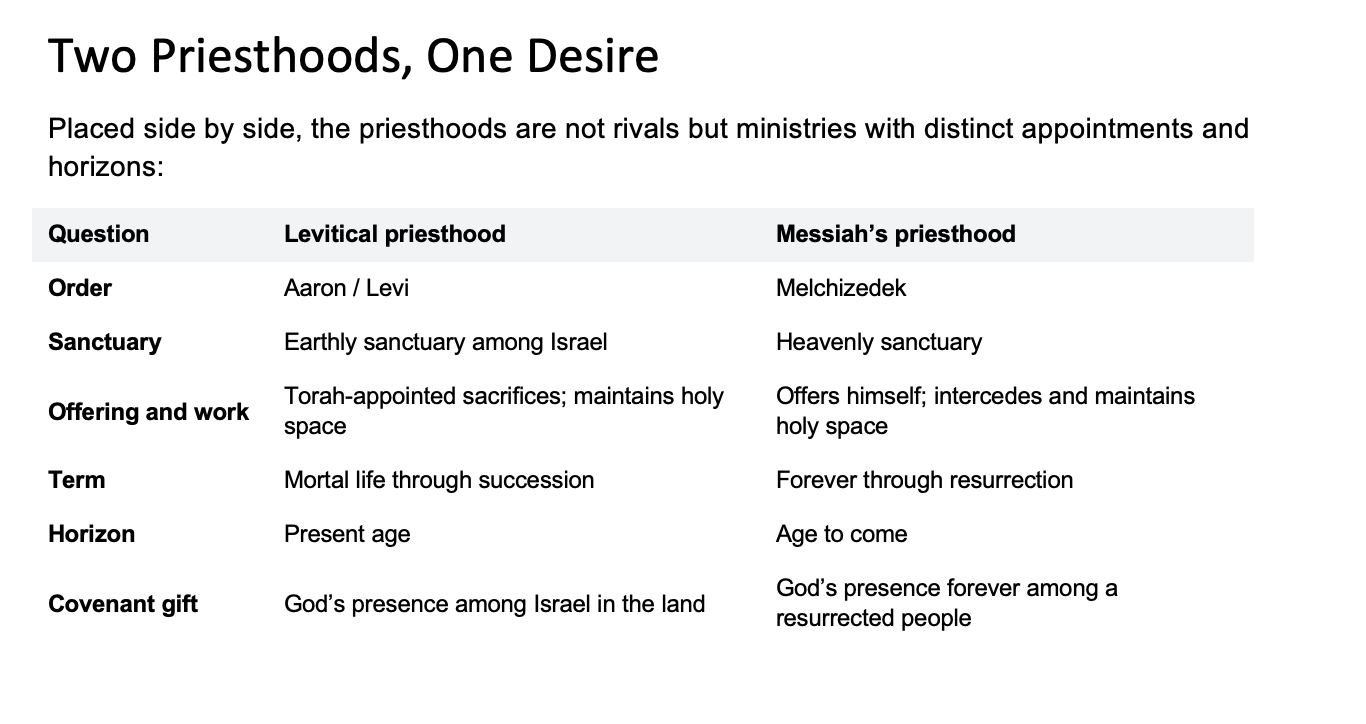
A Priesthood That Reaches Beyond Death
Like the Levites, Messiah performs priestly ministry. Unlike the Levites, he does not offer an animal. He offers himself and presents his own blood. He intercedes continually for his people. Revelation even portrays his heavenly ministry with imagery drawn from Israel’s sanctuary: he walks among lampstands, prayers rise like incense, and faithful witnesses wait beneath an altar.
But Messiah’s priesthood is not sustained through a line of successors. Hebrews says he became a priest not on the basis of ancestry but “through the power of an indestructible life” (Hebrews 7:16). Death cannot terminate his office. The risen priest remains forever.
Aaron’s priesthood continues through succession. Messiah’s priesthood continues through resurrection.
That distinction helps us see why his priesthood reaches toward the age to come: the age of resurrection and renewed creation, when heaven and earth are finally united and God dwells with his people forever.
Flesh and blood cannot inherit that kingdom. Mortal, corruptible humanity cannot simply walk into the unveiled presence of God unchanged. If we are going to live with God forever, we are going to need some new hardware!
This is why we need a priesthood whose ministry reaches beyond the conditions of the present age. Messiah has already passed through death and entered resurrection life. He has gone ahead of us into the life of the world to come—not just to show us that such life exists, but to secure our inheritance there.
The Levitical priesthood makes it possible for the holy God to dwell among mortal people in this present creation.
Messiah’s priesthood makes it possible for mortal people to be remade and dwell with God forever.
These priesthoods are not competitors. They belong to different orders, serve in different sanctuaries, accomplish different kinds of purification, and reach toward different covenantal horizons.
Yet both reveal the same extraordinary desire within the heart of God: to dwell with his people.
The Priest Is Alive
God did not stand at a safe distance and tell mortal, sinful humanity to find its own way back to him. He provided the covenant. He provided the sanctuary. He provided the priesthood. He provided the sacrifice. And ultimately, he provided the priest who could carry human life all the way through death and into resurrection.
Every movement toward God begins with something God has already provided.
That means our life with God does not rest upon our ability to hold everything together. Israel could not hold everything together. Her worship has been interrupted. Her sanctuary has been lost. Her people have endured exile, even to this day. But interruption is not abandonment. God remains faithful to his covenant, even through long seasons when we struggle to see how his purposes will continue.
There are seasons when the form of worship we have known changes. Things we believed would remain may not remain. Places, institutions, ministries, relationships, and communities that helped us meet with God can become fragile—or sometimes even disappear. The pain of that experience is real. But our confidence does not rest in our ability to preserve every structure. It rests in the faithfulness of the God who keeps covenant across generations.
The priest is alive.
He has not retired. He has not been replaced. He has not abandoned his post. Wherever the future takes us, we have not been left without access to God.
Shadows of the Things to Come
Hebrews calls the earthly sanctuary, its priesthood, its sacrifices, and its rhythms shadows of heavenly things. Paul uses similar language in Colossians 2 when he brings up Israel’s festivals, new moons, and Sabbaths: “These are a shadow of the things that are to come; and the reality is found in Messiah.”
Notice Paul’s tense. They are shadows of things to come—things still ahead of us, not something already passed. A shadow is precious because it tells us that something real is near.
When we remember Passover, welcome Sabbath, rehearse the holy days, or receive the bread and the cup, we are not reenacting something old. We are allowing God’s promised future to become tangible for a moment in the present. We are practicing, in small and embodied ways, for life in the world to come.
If I told my children, “Shabbat no longer matters. Lighting the menorah at Hanukkah no longer matters. Building the sukkah in the backyard each fall isn’t important,” they would be crushed! They would look at me as though I had stolen Christmas—which, for the record, we also celebrate!
For our family, these practices have become little tastes of home. They allow us to reach backward and remember God’s faithfulness to his people while reaching forward toward everything he has promised. The fullness is not here yet. But the shadow is growing stronger, and the table has already been set.
Bread, Wine, and the Table of Messiah
Long ago, Melchizedek—the king of righteousness, king of peace, and priest of God Most High—came out to meet Abram after a great victory. He set out the bread and the wine.
Many generations later, at the Passover meal before his death, Jesus gathered his disciples around another table. He took bread, blessed God, broke it, and gave it to them. Then he took the cup and said, “This cup is the new covenant in my blood.”
But Jesus also pointed them beyond that room. He said he longed for day when he would drink the fruit of the vine anew in the kingdom. Scripture promises that when he returns to reign in fullness, he will host a huge banquet on a mountain in Jerusalem, where people will come from east and west to take their places at the table with Abraham, Isaac, and Jacob.
The disciples will be there. Moses and Elijah will be there. Miriam and Junia will be there. People from every generation and every nation who have worshiped the God of Israel will gather around that table.
Imagine the stories that will be told! Imagine hearing what God accomplished through lives we never knew and places we never saw. Imagine talking together about all the wonderful things unfolding in a world finally governed by the Messiah!
And then our risen King and eternal high priest will stand. With nail-scarred hands, he will lift the bread, bless God, and break it.
Our high priest is preparing us for that day.
Every time we come to the table, we look in three directions.
We look backward—to the covenant already cut and the offering already made.
We look upward—to the living high priest who now ministers and intercedes for us in the heavenly sanctuary.
And we look forward—to the table of Messiah that is still to come.
The bread and the cup are a taste of a world we cannot yet see. The Table of Messiah is the age to come placed briefly into our hands by our Great High Priest.
The Messiah and the Torah
Jesus faced many mockers and critics in his day. Many of his opponents claimed this rabbi from Nazareth was teaching God’s people to abandon his Torah, but he was quick to correct this misinformation.
This essay is adapted from the third message in The Meaning of Messiah, a series exploring Jesus through the eyes of the Hebrew Scriptures.
“Do not think that I have come to abolish the Torah or the Prophets.”
Jesus faced many mockers and critics in his day. Many of his opponents claimed this rabbi from Nazareth was teaching God’s people to abandon his Torah, but he was quick to correct this misinformation.
“Do not think that I have come to abolish the Torah or the Prophets; I have not come to abolish them but to fulfill them. For truly, I say to you, until heaven and earth pass away, not an iota, not a dot, will pass from the Torah until all is accomplished. Therefore whoever relaxes one of the least of these commandments and teaches others to do the same will be called least in the kingdom of heaven, but whoever does them and teaches them will be called great in the kingdom of heaven” (Matthew 5:17–19).
Right in the middle of the most famous sermon the world has even known, Jesus affirms the ongoing authority of the Torah in God’s redemptive plan.
He does not speak like someone embarrassed by Torah or treat it as irrelevant to his mission. He insists upon its ongoing authority and warns that whoever relaxes even its least commandments will be called least in the kingdom.
Our Master believed that the kingdom of God was within reach in his generation, which he why he preached a message of repentance: “Repent, for the kingdom is at hand!” If God’s kingdom was arriving, then Jesus believed God’s standards mattered. As Messiah and King, Jesus understood that when the kingdom comes, the king comes. And our task today is to understand how he intends to rule.
Israel’s kings were never free to invent their own moral order. The king was to know God’s instruction, study it, live beneath it, and uphold it. If Jesus is the Messiah, and the Messiah is a king, then we must ask what kind of government rests upon his shoulders? What relationship does his kingship have with God’s Torah? And why does any of that still matter for us today?
A King Formed by Torah
For many Christians, the Torah is often viewed as the part of the Bible Jesus came to free us from. But Jesus does not say that in Matthew 5. To understand what kind of Messiah he believed himself to be, we need to ask what kind of king the Scriptures presented him with.
The Torah answers that question long before Israel ever places a king upon a throne.
In Deuteronomy 17, as Israel prepares to enter the land, God gives his people a blueprint for their future king. He must be chosen by God and come from among his brothers. Unlike the kings of the surrounding nations, he must not build his security through military power, political alliances, personal excess, or accumulated wealth. Everything about his reign must remain beneath the authority of God.
The king’s security, power, and reputation must come through covenant faithfulness to Yahweh—not through the ways of the nations.
Then God gives such a remarkable requirement:
“And when he sits on the throne of his kingdom, he shall write for himself in a book a copy of this Torah, approved by the Levitical priests. And it shall be with him, and he shall read in it all the days of his life, that he may learn to fear the LORD his God by keeping all the words of this law and these statutes, and doing them, that his heart may not be lifted up above his brothers, and that he may not turn aside from the commandment, either to the right hand or to the left” (Deuteronomy 17:18–20).
The king must write his own personal copy of the Torah!
He cannot let the priests summarize it for him, keep a pretty ceremonial copy on a shelf, or memorize a few of his favorite passages. He must write it by his own hand, submit his manuscript to the priests for scrutiny, and then read it every single day for the rest of his life.
Torah is not merely a set of rules the king enforces upon everyone else. Torah is the wisdom that forms the king himself. It shapes his mind, his heart, his loyalties, his humility, and his obedience. If Jesus believed he was the Messiah, then he did not merely need David’s royal blood or Abraham’s Jewish blood. He needed to become this kind of king: a Deuteronomy 17 king who knows God’s instruction, lives it, and can teach it because he has spent his life mastering it.
The Messiah is a Jewish king. And a Jewish king must be a Torah scholar.
What Does the Messiah Do With Torah?
Torah can refer broadly to the first five books of Scripture, sometimes called the Pentateuch. But the word Torah means instruction or teaching. It reveals God’s wisdom for human life and flourishing in God’s good world, so it makes sense that the Messiah does not spend his life studying that wisdom for his own sake. The prophets give him a two-part mission:
He must teach God’s Torah to the nations.
He must renew Israel so that God’s covenant people can finally uphold it.
Isaiah 2 describes the first part of this mission. In the last days, the mountain of Yahweh’s house will be established, and the nations will stream to Jerusalem. They will say:
“Come, let us go up to the mountain of the LORD,
to the house of the God of Jacob,
that he may teach us his ways
and that we may walk in his paths.
For out of Zion shall go forth the law,
and the word of the LORD from Jerusalem” (Isaiah 2:3).
This is not just a slow trickle; this is a steady stream of people from the nations coming to Jerusalem to learn the ways of Israel’s God. They make a long journey, learn this wisdom, but they don’t remain there. Returning back home, they bring the good news of the Torah back to their regions—the Torah going forth from Zion—and teaching the world how to live beneath God’s rule. The result is righteous judgment between nations: settled disputes, economic harmony, ecological stewardship and abundance, and eventually the end of war.
This is the world beneath the wise government of God’s king. The kingdom is centered in Israel, but its blessing reaches the entire world. Torah was entrusted to Israel so that Israel might model for humanity the wisdom and ways of its Creator.
But Isaiah’s vision is only half the story. Before Torah can go forth from Zion to the nations, Israel herself must be renewed to walk in God’s ways and fulfill her calling.
The New Covenant Is Not Torah’s Funeral
When many Christians hear the phrase new covenant, it is easy to almost automatically assume a dichotomy: the old covenant was bad; the new covenant is good. The old was law; the new is grace. The old must disappear so the new can take its place.
This rhetoric is so deeply embedded within parts of Christianity that it’s hard to even recognize it. But we must understand that this reasoning is not consistent with how the prophets or apostles describe the new covenant.
The new covenant is not God scrapping Torah. It is God renewing his people—the Jewish people—so that they can live faithfully within his instruction.
The Torah is good; the human heart is what’s stubborn. So God does not promise, “I‘ll get rid of my Torah.” Of course he cannot get rid of the Torah! It’s his wisdom, his standard. It’s upon the wisdom of Torah he founded the world. So God says “I’ll send my Messiah to transform the hearts of my people.”
Hebrews 8 quotes Jeremiah’s new-covenant promise at length:
““For if that first covenant had been faultless, there would have been no occasion to look for a second. For he finds fault with them when he says,
Behold, the days are coming, declares the Lord, when I will establish a new covenant with the house of Israel and with the house of Judah…. For this is the covenant that I will make with the house of Israel after those days, declares the Lord: I will put my laws into their minds, and write them on their hearts, and I will be their God, and they shall be my people”
In speaking of a new covenant, he makes the first one obsolete. And what is becoming obsolete and growing old is ready to vanish away.” (Hebrews 8:8, 10; quoting Jeremiah 31:31–33).
That final line is an easy to trip over, because at first glance, it makes it sound as though God is done with the Torah; that the Torah is the thing that’s obsolete and passing away. But a slow, careful reading provides a different meaning, one consistent with what Jesus himself taught.
Whom does God find fault with in the first covenant? Verse 8 says he finds fault “with them”—the people, not the Torah, not even the covenant. The people are the faulty party.
With whom does he make the new covenant? The house of Israel and the house of Judah. The new covenant is not with me personally, nor Christians or the church. I am grateful that I am invited to particate in the blessings of that covenant through faith in it’s mediator, but the new covenant is not first or primarily with me.
What does God promise to place within the house of Israel and Judah? His Torah.
And what is becoming obsolete? The first covenant.
This is important. The first covenant is not the Torah. The first covenant is Israel’s agreement to keep the Torah.
The problem was not that God’s Torah was defective or impossible to attain, but that his people did not keep their end of the deal. They did not continue in the covenant.
So the new covenant does not abolish God’s Torah. It recreates God’s people: new hearts, with Torah written within, and the Spirit empowering covenant faithfulness from the inside out.
The new covenant is not Torah’s end, but Israel’s renewed capacity for faithfulness to God.
For the Sake of His Name
By this point, we may be thinking to ourselves, “Ok, that’s all great but why does any of this matter?”
Why must Israel walk faithfully in Torah?
Why must the nations learn it?
Why must the Messiah teach it?
Jesus has already died, risen, and defeated death in his own body. He’s done it! So why does biblical faith still require any of this?
There is one very big reason: if Israel does not walk faithfully in Torah, God cannot dwell in her midst as he promised. If God is not dwelling in Israel, his name is profaned among the nations.
In the world today, this is a present reality. God is not dwelling in his temple in Jerusalem. Israel is not hosting his presence on the land as the prophets envision. And the nations look at Israel and reason: There is no God in Israel. The promises he made to this people are imagined, they’re stories, legands. There is no Messiah. The God of Israel will not do what he said—or he at least meant something different by them. There is no Yahweh God.
This is what today’s world has concluded about the God we worship. The Torah is God’s wisdom for humanity, but ultimately it’s about something greater: God’s reputation. His name.
Through Ezekiel, God tells Israel:
“It is not for your sake that I am about to act, but for the sake of my holy name…. And the nations will know that I am the LORD … when through you I vindicate my holiness before their eyes” (Ezekiel 36:22–23).
Here’s how God is going to vindicate himself:
“My dwelling place shall be with them…. Then the nations will know that I am the LORD who sanctifies Israel, when my sanctuary is in their midst forevermore” (Ezekiel 37:27–28).
God has attached his name to this people and land, and his reputation to their restoration. Israel’s renewed ability to walk in the fullness and wisdom of God’s Torah demonstrates to the world that the God of Israel keeps his word—and that he is the Most High God.
Jesus taught his disciples to pray for precisely this:
“Our Father in heaven, hallowed be your name. Your kingdom come, your will be done, on earth as it is in heaven” (Matthew 6:9–10).
Jesus knew the writings of Ezekiel. He knew God’s name can only be hallowed among the nations when he restores Israel to covenant faithfulness, dwells among his people, and brings the earth beneath his righteous standards.
So let’s follow the logic:
If Israel is not renewed, God cannot dwell among his people as he promised.
If God does not dwell among them, Israel cannot fulfill her calling as a light to the nations.
If Israel cannot be a light to the nations, the nations will never learn the wisdom and ways of Israel’s God.
And if the nations never learn God’s ways, evil just keeps going.
The world cannot heal itself. But Yahweh does not fail. He has not forgotten his people or abandoned his Torah.
God has installed his Messiah to bring Israel and the nations into alignment with God’s wisdom.
The cross and resurrection are not alternatives to that mission. They are the decisive victory guaranteeing that the Messiah will complete it.
This is why Torah still matters. That is why the Messiah being a Torah scholar still matters. He has not yet completed all that the Torah and the Prophets teach. Jesus did not come to throw out Moses and replace Torah with grace, but to be the king who brings Israel and the world into alignment with the wisdom of God.
The Messiah Steps Into His Role
When Jesus ascends the mountain in Matthew 5, gathers the Jewish people and begins to teach Torah, he is not offering spiritual tips or making the Torah a matter of the heart.
He is beginning the work the Scriptures assigned to Israel’s Messiah.
He speaks with the authority of a king, teaching God’s people how to walk in God’s ways. He exposes shallow and selective obedience and presses the wisdom of Torah to it’s farthest extent.
“You have heard that it was said, ‘You shall not murder,’” Jesus tells the crowd. Then he calls out the anger and contempt from which murder begins.
“You have heard that it was said, ‘You shall not commit adultery.’” Then he expands beyond outward restraint and exposes what faithfulness and holiness means in some of the most important relationships we can have in this life.
He speaks about oaths, retaliation, and love of enemies, pushing the Torah’s wisdom to is limits: integrity, mercy, and true righteousness.
Jesus does not waive Torah. He intensifies it, clarifies it, and administers it as the king who understands its goal.
Then, at the end of Matthew, Jesus stands on another mountain. Having received all authority in heaven and upon earth, he sends his disciples to the nations:
“Go therefore and make disciples of all nations … teaching them to observe all that I have commanded you” (Matthew 28:19–20).
The king of Israel, enthroned over heaven and earth, sends his disciples to instruct the nations in the ways of God. Doesn’t that sound like Isaiah 2?
The Messiah has not yet finished this work. The vision of the Torah and the Prophets is much larger than anything we have yet seen. The nations have not streamed to Zion. War has not ceased. Israel and Judah have not been fully renewed. God’s dwelling has not been restored in Jerusalem, and the earth has not come beneath the Messiah’s wise instruction.
Our king has begun the work, and he will finish it when he reigns in fullness.
You Have Heard It Said
In our day, we, too, have heard it said…
that he Torah does not matter anymore,
that God is finished with all that Old Testament stuff,
that Jesus abolished the law,
that Hebrews says it is all obsolete anyway.
But Jesus says, “Do not think that I have come to abolish the Torah or the Prophets.” Our question is not, What do I believe about Torah? but whether I have submitted myself to learning its wisdom? Have I allowed the Scriptures that formed Jesus to teach me who he is, how he intends to govern the world, and how he intends to reign over my life now?
Psalm 1 describes the righteous man this way:
“His delight is in the law of the LORD,
and on his law he meditates day and night” (Psalm 1:2).
Those words are portrait of Israel’s Messiah. If we love Jesus, then we need to love the things he loves. And Jesus loves God’s Torah. He meditates upon it. He lives it. He teaches it. And the government we hope will one day rest on his capable shoulders and heal the world is grounded in the wisdom revealed there.
Open the Scriptures that formed your king. Read them slowly—day by day, year by year. You have heard it said that Torah is over, but Jesus says otherwise. Are willing to sit at the feet of our King and learn?
“Teach me, O LORD, the way of your statutes;
and I will keep it to the end” (Psalm 119:33).
The Messiah is a King
Every Easter, Christians around the world remember the sign that hung above Jesus as he died on the cross: Jesus of Nazareth, King of the Jews. We've heard those words so many times that they can become over-familiar. Why that charge?
The following essay is adapted from a message I shared at Friends Community Church, essay #2 in The Meaning of Messiah.
Every Easter, Christians around the world remember the sign that hung above Jesus as he died on the cross:
Jesus of Nazareth, King of the Jews.
We've heard those words so many times that they can become over-familiar. Why that charge?
Rome did not crucify people for loving their neighbor. Crucifixion was typically reserved for those who threatened the authority of Caesar— insurrectionists, rebels, political rivals, and anyone accused of challenging Rome's rule.
To declare Jesus the Messiah was to openly admit that he was the rightful king of the Jews.
Rome did not appreciate that claim. They liked the king they had appointed to rule in Jerusalem. Neither did many of the religious leaders who held power in Jerusalem, especially the Sadducees. To keep the temple operational, the Sadducees who controlled it needed to keep Rome happy. Yet Jesus never denied his charge. In fact, he was willing to die for it.
He didn't have to. In the wilderness, the tempter had already offered him the kingdoms of the world if he would simply bow in worship (Matthew 4:8–10). Jesus could have pursued a kingdom by seizing power for himself. Instead, he refused. He would wait for his Father to bestow the kingdom upon him, not grasp it by his own strength. The crown would come, but it would come the Father’s way.
So what did it mean to Jesus to be the King of the Jews? To answer that question, we have to return to the Scriptures that taught him what kind of king the Messiah would be.
A Scepter Rising from Israel
One of the Bible’s earliest portraits of Israel’s coming king appears near the end of Genesis.
Jacob is dying. He gathers his sons around him and speaks prophetic words over the tribes that will descend from them. When he comes to Judah, his language becomes unmistakably royal:
“Judah, your brothers shall praise you;
your hand shall be on the neck of your enemies;
your father’s sons shall bow down before you.”
—Genesis 49:8
Judah is associated with leadership, honor, victory, and authority. His hand rests on the neck of his enemies. His brothers bow before him.
Then Jacob compares Judah to a lion resting securely after victory. No one dares disturb him. His enemies have been defeated, his authority is unchallenged, and his kingdom is secure.
But the clearest royal image arrives in the next verse:
“The scepter shall not depart from Judah,
nor the ruler’s staff from between his feet…
and to him shall be the obedience of the peoples.”
—Genesis 49:10
A scepter is the symbol of a king’s authority. The ruler arising from Judah will not merely lead one family or govern one tribe. The peoples will obey him. The horizon is already widening beyond Israel toward the nations.
This picture appears again in Numbers, when Balaam sees a ruler who has not yet arrived:
“I see him, but not now;
I behold him, but not near:
a star shall come out of Jacob,
and a scepter shall rise out of Israel.”
—Numbers 24:17
The image planted in Genesis has begun to grow. A king will arise from Judah. The scepter belongs to Israel. This ruler will defeat his enemies, exercise dominion, and receive the allegiance of peoples beyond his own. One of the earliest portraits of Messiah is a royal, political, governmental, kingdom-oriented leader.
This is where Jesus’s understanding of his own kingship began: not in Rome’s ideas about power, but in the Torah’s promise of a scepter rising from Israel.
A House for David
When we continue down the trail that is the Hebrew Bible, we turn the page into the Former Prophets, and find David in 2 Samuel 7. The man of war has finally reached a blessed season of rest. Israel’s enemies have been subdued, the tribes united. David’s kingdom is secure, and he’s living in a beautiful palace. As he looks around, one thought begins to bother him: "I live in a house of cedar, but the ark of God still dwells in a tent."
David wants to build God a house. God responds by promising to build one for David; not a building, but a dynasty—a royal line that will carry David’s throne and kingdom into the future.
“When your days are fulfilled and you lie down with your fathers, I will raise up your offspring after you, who shall come from your body, and I will establish his kingdom. He shall build a house for my name, and I will establish the throne of his kingdom forever.”
—2 Samuel 7:12–13
The promise contains four essential elements:
a son,
a kingdom,
a throne,
and a reign that endures forever.
Solomon would fulfill part of this promise. He was, of course, David’s son. He inherited the kingdom, sat on David’s throne, and built a house for God’s name. But Solomon did not reign forever. God’s promise was larger than Solomon. It created an expectation that grew throughout the prophets: a future son of David would inherit an eternal throne and rule over a kingdom without end.
By the time Jesus was born, Israel had gone centuries without a Davidic king on the throne.
The Babylonians had come and gone. The Persians had come and gone. The Greeks had come and gone. The Maccabean revolt had briefly returned Jewish rule to the land, but the Hasmoneans were a priestly family, not heirs of David. Then Rome installed Herod the Great as “King of the Jews.” Herod was an Idumean, not a son of David. He occupied a throne in Jerusalem, but he was not the king Israel’s Scriptures had promised.
The throne existed, but the rightful dynasty had not been restored. Israel was still waiting for David’s heir.
That is why the title "Son of David" carries such enormous significance throughout the Gospels. It is far more than a statement about Jesus's ancestry. It is a messianic confession. Calling Jesus the "Son of David" decalres, "You’re the promised heir. You are the King God swore would come!"
Notice how the portrait continues to sharpen. The Torah introduced us to a king holding a scepter. The Prophets identify that king as the covenantally promised Son of David—the rightful heir to Israel's throne whose kingdom will never end.
And when we turn to the Psalms, David himself begins describing what this coming king will actually do.
Psalm 2
Psalm 2 opens with a question:
"Why do the nations rage and the peoples plot in vain?"
Immediately, we discover that the Messiah's enemies are raging in rebellion—not only against the Lord, but against his Anointed King. So what does God's King do?
First, he rules the nations. God declares, "Ask of me, and I will make the nations your heritage." The Messiah's authority extends far beyond Israel. He is not simply a tribal king. He is the King of other kings.
Second, he confronts rebellion. The Messiah does not ignore the world's resistance to God. He answers it.
Third, he reigns from Zion. "I have set my King on Zion, my holy hill. David envisions a real king, reigning from the city God has chosen.
Finally, he establishes justice by shattering "them with a rod of iron." This is often where modern readers can begin to feel uncomfortable.
Psalm 2 does not begin by presenting the Messiah as a comforter or a healer. Those themes certainly appear elsewhere in Scripture, and we'll explore them in the future. But the Psalm’s first portrait is that of a king with enemies who judges evil, shatters those in rebellion, and establishes righteous rule.
The psalm concludes by calling the powerful of the earth to humble themselves before God's Anointed:
"Serve the LORD with fear... Kiss the Son... Blessed are all who take refuge in him."
Psalm 110
The New Testament authors are obessed with this Psalm. It’s the most frequently quoted Old Testament passage in the New Testament. Clearly, Jesus and the apostles considered it indispensable for understanding the Messiah!
The psalm opens:
"The LORD says to my Lord: 'Sit at my right hand until I make your enemies your footstool.'"
The Messiah is invited to sit beside God in the place of highest honor and authority. But notice the purpose of that authority. It continues until his enemies are placed beneath his feet.
The psalm goes on to describe the Messiah extending his rule from Zion, gathering a willing people around himself, and ultimately shattering opposition on the day of God's wrath. Once again, these expectations are consistent with the Torah’s portraits.
The Messiah reigns.
He subdues his enemies.
He extends his kingdom.
He gathers a faithful people.
He shatters rebellious rulers.
For many Christians, this is not the first picture of Jesus that comes to mind. Many of us tend to envision Jesus first as the suffering servant, the compassionate healer, the friend of sinners. Those portraits are profoundly true, and in the coming weeks we'll spend time with Isaiah's beautiful descriptions of the Messiah's humility, compassion, sacrifice, and suffering.
But it’s worth noting that the primary portrait of the Messiah in the Old Testament is very much the king of Ps. 2 and Ps. 110. Jesus embraced all of it, not just the parts that were easy to accept.
The question isn’t whether we prefer one portrait over the other, but whether we allowed these Psalms to teach us who the Messiah is?
The Life of Jesus
After everything we've seen in the Torah, the Prophets, and the Psalms, one question naturally remains: Did Jesus actually understand himself this way?
I believe the answer is yes. In fact, once you begin looking for it, you see it everywhere.
Confronting Rebellion: Jesus begins his public ministry announcing, "Repent, for the kingdom of heaven is at hand." He does not arrive proclaiming a new philosophy or inviting people to join a new religion. He announces that God's kingdom is arriving, and when it arrives, its king does not take lightly to those who rebel against God’s ways.
Reclaiming Territory: As he travels through Israel, Jesus also confronts the powers of darkness. For many years I envisioned Jesus’ exorcisms more as a compassionate act of healing. I now see it’s much more than that. Casting out unclean spirits is an act of conquest. Jesus himself compares his own actions to binding the strong man before plundering his house. If the house is the land of Israel and the Jewish people are the plunder Jesus has come to reclaim, then to take that back, one must first bind the strong man holding them captive. This is exactly what we see Jesus doing in his lifetime—traveling around the land of Israel and reclaiming God’s people so that he can take back the house. He is a king reclaiming territory from an enemy.
Gathering a People: He gathers disciples around himself, just as Psalm 110 anticipated: "Your people will offer themselves freely." He forms a people whose primary allegiance belongs to him.
Reigning in Authority: After his resurrection, he declares, "All authority in heaven and on earth has been given to me." The language echoes Psalm 2, Psalm 110, and Daniel 7. This is why when the crowds cry, "Hosanna to the Son of David," they are making a messianic confession. They believe the promised King has arrived, choosing sides for the battle Ps. 2 describes because they believe it’s about to begin.
The Unfinished Psalms
Here we encounter the beautiful tension at the heart of the gospel: Psalm 2 is not finished. Psalm 110 is not finished.
The nations still rage. Wars continue. Death still reigns. Justice has not yet filled the earth. Not every enemy has become the Messiah’s footstool.
That does not mean Jesus is not King. It does not mean his kingdom has dissolved into a spiritual metaphor or that God has abandoned his promises concerning the earth. It means the story is not over.
The victory is certain, but the King still has work to do. The Scriptures present one King with one mission. The cross was never the end of that mission. It was the path to the throne.
If this is the King of the Jews Jesus believed himself to be, what kind of disciples should we become?
First, we must become citizens.
Disciples of the Master are not merely people who believe certain things about Jesus. We are people who have pledged allegiance to a King we cannot yet see and to a kingdom that has not yet arrived in fullness.
It will not always be invisible, but it is for now.
Our highest allegiance therefore belongs to King Jesus—above every ruler, nation, cultural loyalty, and competing claim upon our lives. We must learn to order our lives under his reign now while waiting for the day his reign fills the earth.
We must also become students.
Jesus commanded his followers to make disciples of the nations, “teaching them to obey everything I have commanded you.” A disciple is a student, a person who learns. Jesus expects his followers not merely to attend, believe, or feel inspired, but to learn.
If Jesus learned the meaning of his mission from the Torah, the Prophets, and the Psalms, shouldn’t we learn to recognize him through those Scriptures too? Discipleship calls us back—to sit at the feet of our Teacher and allow the whole testimony of Scripture to reshape the way we see him.
Learning should be a huge part of our lives as disciples of Jesus.
Finally, we must become hopeful people.
If Psalm 2 and Psalm 110 remain unfinished, then history is not spiraling beyond God’s control. It is moving toward the day when every enemy will be placed beneath the King’s feet. Scripture does not pretend the road to that kingdom will be easy. But its promised destination changes how we live along the way.
It changes how we pray: Thy kingdom really does need to come to the land.
It changes how we endure: Be faithful unto death, and I will give you the crown of life.
It changes how we live in exile: build houses, plant gardens, and seek the peace of the places where God has placed us.
It changes how we hope: while we can seek to better this world with the love and teachings of our Lord, we must not confuse that work for earnestly hoping and eagerly waiting for the city that is yet to come.
And so, we return to the sign: Jesus of Nazareth, King of the Jews.
The question is not whether the sign was true. The question is whether we understand what it means?
Those words announce that Jesus believed he had come to inherit the throne promised to David, reclaim the nations for God, defeat every enemy, and establish the house of the Lord and the kingdom proclaimed throughout the Torah, the Prophets, and the Psalms.
Do we believe the things Jesus believed about himself? Praise God that he is faithful to meet us in that work.
May we become people who do not merely confess, “Jesus is Lord.”
May we become faithful citizens of his coming kingdom—trusting our King as Abraham trusted the promises of God, ordering our lives around his teaching today, and eagerly hoping for the day when we see him face to face.
The Meaning of Messiah
If we are going to follow him faithfully, then our understanding of Jesus must be shaped by who he says he is, not merely by who we say he is.
The following essay is adapted from a message I shared at Friends Community Church, the first in The Meaning of Messiah.
When I was growing up, my poor mom was almost never introduced by her own name. She was "Brianna's mom," or "Ray's wife," or somebody's whatever-she-happened-to-be. To this day, people will still introduce her that way: "This is Brianna's mom." It's actually kind of funny. People know who she is primarily by her relationship to someone else.
As people, we do this all the time. When we introduce others, we instinctively describe them by their relationship to us. "This is my husband, Mike." "This is my mom, Carolyn." "This is my friend..." We define people through the categories that make the most sense to us, but those categories are rarely how people introduce themselves. My mom doesn't walk up to strangers and lead with, "Hi, I'm Brianna's mom." Eventually that relationship may come up, but it isn't the foundation of her identity. It is the foundation of how I know her, but not the foundation of how she knows herself.
I think we often do this very same thing with Jesus.
When we talk about him, we tend to begin introducing him to others in the ways that have meant the most to us personally. We call him Savior, Friend, Teacher, or Rescuer. Every one of those titles is true. They are beautiful, biblical descriptions of who Jesus is.
But are those the categories Jesus would have chosen to introduce himself?
When Jesus asked his disciples, "Who do you say that I am?" he wasn't asking strangers. The question was directed at the people who had spent the most time with him, probing whether they truly understood his identity. It is a question that still confronts every one of us today.
If Jesus were introducing himself to us, what title would he place first? How did he understand his own mission? Who is Jesus?
I have a friend who wrestles searches for answers to this question constantly. Over the years, he has heard liturgy that now feels empty to him. He has listened to passionate sermons. He's encountered cultural ideas about Jesus—billboards, commercials, along with familiar phrases like, "Jesus loves you," "Jesus died for you," and "Make Jesus Lord of your life." The problem is that every person seems to describe Jesus a little differently. Each one gives him a slightly different version, and it has left him with the impression that Jesus is simply whoever someone says he is—whoever someone wants him to be.
Our personal testimonies matter. They’re important. They are evidence of God’s faithfulness in our lives. To the addict, Jesus is the one who breaks chains. To the lonely, he is a faithful friend. To the brokenhearted, he is a healer. To the desperate, he is a rescuer. Those stories are real, and they deserve to be told.
But alone, they are not enough.
If we are going to follow Jesus faithfully, there comes a point where we must mature beyond simply talking about what Jesus has done for us and begin asking who Jesus understood himself to be. Our witness may begin with our story, but it must ultimately grow into Jesus' story about himself.
Otherwise, we are left to worship a Jesus of our own making.
If we are going to follow him faithfully, then our understanding of Jesus must be shaped by who he says he is, not merely by who we say he is.
The Question—Who did Jesus believe himself to be?
In John 4, Jesus has a remarkable conversation with the Samaritan woman at the well. As they speak about worship, she tells him, "I know that Messiah is coming. When he comes, he will teach us all things." Jesus responds with an astonishing declaration: "I who speak to you am he."
Jesus openly identifies himself as the Messiah she’s waiting for. But that answer only leads to another question: What exactly is a Messiah?
When the woman says the Messiah will "teach us all things," what are those "all things" she has in mind?
She had a very defined expectation of the Messiah, but do we?
Is there a way to outline the role, the mission, and the responsibilities of the one God promised to send?
Jesus certainly thought so. He learned about the Messiah from the Scriptures. They shaped his understanding of who he was, why he came, and what God was doing in the world.
That is why, when Jesus stood up in the synagogue at Nazareth and read from Isaiah,
"The Spirit of the Lord is upon me, because he has anointed me to proclaim good news to the poor... to proclaim the year of the Lord's favor..." (Luke 4:18–19)
he knew exactly what he was claiming about himself.
The real question is whether we do.
Who were the captives Isaiah was talking about? What is "the year of the Lord's favor" and when does it arrive? What office was Jesus claiming to occupy when he declared that he was the anointed one?
Those are the types of questions that will guide this series.
Over the next several weeks, my goal is to help us learn to see Jesus the way Jesus saw himself. We are going to understand the Messiah through the very Scriptures that shaped his own understanding of his mission. More than that, we're going to ask what it actually means to confess that Jesus is the Messiah.
To do that, we're going to begin where Jesus himself directed his followers after the resurrection: Luke 24.
The Scriptures—Jesus Learned About His Mission
After his resurrection, Jesus encountered two discouraged disciples on the road to Emmaus. They knew the events of the crucifixion. They knew the reports of the empty tomb. They were hoping this man who had been killed at Passover was the one who would “redeem Israel.”
Jesus' response is striking.
He does not begin by appealing to their personal experience, telling them about the death he suffered. He does not perform a miracle. Instead, Luke tells us that, "beginning with Moses and all the Prophets, he interpreted to them in all the Scriptures the things concerning himself" (Luke 24:27).
To appreciate what Jesus is doing, it helps to understand the structure of the Bible he was reading.
The Hebrew Scriptures—what Jewish people often call the Tanakh—are traditionally divided into three sections:
the Torah (the books of Moses),
the Prophets,
and the Writings.
The Torah includes Genesis through Deuteronomy. The Prophets include not only Isaiah, Jeremiah, and Ezekiel, but also Joshua, Judges, Samuel, and Kings. The final section, the Writings, includes books like Psalms, Proverbs, Daniel, Ezra-Nehemiah, and Chronicles.
Sometimes Jesus refers to these three sections as "Moses, the Prophets, and the Psalms," using Psalms—the largest book in the Writings—as a shorthand for the entire final section. “Moses” works the same way—it means the Torah. In other words, Jesus points these discouraged disciples to the whole Hebrew Bible.
Why? Because that is where the Messiah is defined.
A few verses earlier, Jesus asks, "Was it not necessary that the Messiah should suffer these things and enter into his glory?" (Luke 24:26).
Notice the language carefully. Jesus doesn't begin by saying, "I had to suffer," speaking in the first person. He says, "The Messiah had to suffer." Jesus is thinking of his own death and resurrection not as something that happened to him personally, but in terms of an office—a role, a vocation, a mission.
An illustration can help. The President of the United States is an office. Today, Donald Trump occupies that office. Before him, others occupied it. Long after him, others will as well. The office itself exists independently of the individual. It carries defined responsibilities, authority, expectations, and duties because the Constitution of the United States establishes what a president is supposed to do as well as the credientials one must have to occupy the office.
The same is true of the Messiah. Jesus is a person. Messiah is an office.
Long before Jesus was born, the Hebrew Scriptures had already described that office. They define what qualifies someone to be the Messiah, what the Messiah is expected to accomplish, why the Messiah suffers, what he inherits, how he reigns, the length of his term, and what God's purposes for him are.
Jesus understood himself as stepping into an existing role. He did not invent the office; he inherited it. That is why he continually returned to the Scriptures. His point was not simply, "Look what happened to me." His point was, "Surely you know—this is what the Messiah must do!"
Once the disciples began to see that pattern in the Scriptures, the identity of Jesus became unmistakable. That is why I think we need to begin here as well. Before we ask what Jesus means to us, or even what he has done for us, we should first ask a more fundamental question: What did Jesus think it meant to be the Messiah?
Because if Jesus understood himself through the office of Messiah, then we need to understand that office too.
What is a Messiah?
The word Messiah comes from the Hebrew word Mashiach. The word Christ comes from the Greek Christos. They are not two different titles. Christos is simply the Greek translation of the Hebrew Mashiach.
Messiah. Christ. Same title. Different languages.
The Hebrew word Mashiach means "anointed one." More literally, it refers to someone who has been anointed with oil.
Throughout the Scriptures, anointing was the act of setting a person or object apart for God's purposes. It marked something as belonging to God and being commissioned for a holy task. People were anointed. Sacred objects were anointed. Even altars and stones could be anointed. Anointing was God's way of publicly designating something for his service.
One of the most surprising discoveries for many Christians is that the Bible doesn't contain only one messiah. It contains many.
Aaron was an anointed priest. David was an anointed king. Solomon was an anointed king. Even Cyrus, the Persian ruler, is called God's anointed in Isaiah 45.
The Scriptures are filled with mashiachs—anointed ones. Priests, kings, prophets, judges, leaders, and deliverers all carry this designation in one way or another. When Jesus spoke about "the Messiah," he wasn't introducing a brand-new concept. He was stepping into a category the Scriptures had been developing for centuries. And this is where things become fascinating.
Each of these anointed figures reveals something about the work of the coming ultimate Messiah. Aaron teaches us about priesthood. David teaches us about kingship. Moses reveals what it means to lead God's people and mediate between God and Israel. The prophets demonstrate what it looks like to speak God's word faithfully. Each one contributes another brushstroke to an unfinished portrait. Together, they create the expectation of an anointed one who would accomplish everything God's earlier servants could accomplish only in part.
When Jesus read the Scriptures, these were the portraits he encountered. These were the categories that shaped his understanding of his own mission. The title "Messiah" was never a label that Jesus was free to define however he wished. Long before he was born, the Scriptures had already begun filling that title with concrete meaning.
That is why the opening verse of Matthew's Gospel is so significant.
The Messiah is Jewish
"The book of the genealogy of Jesus the Messiah, the son of David, the son of Abraham."
Most of us are eager to skip over the long list of unfamiliar names and get to the "important" parts. Matthew has other ideas. He is introducing us to Jesus's messianic credentials. The first thing Matthew wants us to understand is that the office of Messiah is thoroughly Jewish.
In order to be the Messiah, one must be Jewish.
Christianity did not invent Christ. Jesus did not invent Messiah. Jesus is the Messiah, Christians are disciples of the Messiah, but the Messiah belongs to Israel's story before he belongs to Christianity. To be Messiah, you must belong to the covenant family and story that produced Messiah.
You must belong to Abraham's family. You must stand within Israel's covenant. You must inherit the promises God made to his people.
“Christ” (or Messiah) is not a generic title for a heroic or savior-like figure. It is a covenantal office rooted in the history of Israel.
That is why Matthew begins where he does. He first calls Jesus "the son of Abraham” because in Genesis 12, God chose Abraham and established a covenant with him. Through Abraham's family, God promised blessing, a covenant relationship, and ultimately blessing for all the nations of the earth. From that moment forward, God's redemptive plan for the world would unfold through Abraham's family.
That has never changed.
Jesus is the heir of those promises. Without Abraham, there is no Messiah.
Matthew then identifies Jesus as "the son of David." In 2 Samuel 7, God promised David an everlasting throne, an enduring kingdom, and a descendant who would reign forever. "Son of David" became one of the great messianic titles in Israel because it pointed to God's promise that the coming king would arise from David's royal line. We'll spend much more time exploring that promise in the next message.
But for now, notice what Matthew has done. With a single verse, he places Jesus at the intersection of two great covenant promises.
Abraham points us to the family through whom blessing would come to the nations.
David points us to the King whose kingdom would never end.
Matthew wants us to see that Jesus stands at the convergence of both.
No Abraham, no Messiah.
No David, no Messiah.
No Israel, no Messiah.
No Judaism, no Messiah.
The Mission
When Jesus enters the synagogue in Luke 4, he is handed the scroll of Isaiah, and reads the appointed Haftarah portion for that shabbat. Today we know that as Isaiah 61. I encourage you to go read it in full.
When he finishes reading, he makes an astonishing claim:
"Today this Scripture has been fulfilled in your hearing."
With those words, Jesus publicly announces that he is the one who will bring Isaiah's vision to fullness.
Isaiah 61 is, in many ways, a summary of the Messiah's mission. It describes the work God's Anointed One will accomplish. By reading that passage and declaring its promises underway, Jesus was telling everyone in the synagogue exactly who he believed himself to be.
Most of us, however, were not introduced to Jesus through Isaiah 61. We know the Jesus who forgave us, comforted us, rescued us, who carried us through grief, loss, or uncertainty. Every one of those experiences is real, and every one of them is precious.
But a mature disciple will ask if are they the whole picture?
When Jesus introduced himself, he didn't begin with other people's experiences. He opened Isaiah 61.
Is Isaiah 61 the Jesus you follow?
Do we recognize him as the one who proclaims liberty to captives? The one who comforts those who mourn in Zion? The one who restores ancient ruins and rebuilds ruined cities? The one who causes righteousness to spring up before the nations? The priestly King clothed in righteousness? The one who proclaims both the year of the Lord's favor and the day of God's justice?
Every one of us carries a picture of Jesus. The question is where that picture came from. Was it shaped by the Hebrew Scriptures? By Jesus's own understanding of his mission? Or has it been assembled primarily from our experiences, our traditions, or the fragments of Jesus we've collected along the way?
That is the question I hope this series will, over time, help us answer.
If Jesus learned who he was from the Scriptures, then perhaps we should understand who he is from those same Scriptures too.
Take a few moments to pause and spend some time with two passages: Isaiah 61 and Psalm 110. As you read them, ask yourself a simple question: What did these passages teach Jesus about the meaning of his calling as the Messiah?
The goal of discipleship is to become students of our Teacher. If we call ourselves followers of Jesus, then we are following the Jewish Messiah described by the Hebrew Scriptures. We are disciples of a rabbi from Nazareth.
And if, like the disciples on the road to Emmaus, we want to see the risen Jesus in all his glory and become like him, we must learn to sit at the feet of our Master. We must be covered in the dust of our rabbi.
Jesus's question still stands before us: "Who do you say that I am?"
If we are going to follow Jesus faithfully, we must understand the Messiah he claimed to be.