Where is the Priest?
Why does the New Testament call Jesus our great high priest? And why do we need him to be one? Most Christians have a fairly quick answer: We need a priest because we have sinned, and Jesus offered himself as the sacrifice for our sins. That is true, but there is more to the story.
This essay is adapted from the fifth message in The Meaning of Messiah, a series exploring Jesus through the eyes of the Hebrew Scriptures.
Jesus looks like a king. He is crucified beneath a royal title that says “King of the Jews.”
Jesus looks like a Torah teacher. He interprets Scripture, teaches in synagogues, and insists that he did not come to abolish the Torah.
Jesus looks like a shepherd. He seeks the lost, heals the wounded, feeds the hungry, and gathers the scattered.
But when does Jesus ever look like a priest?
He never offers a sacrifice in the temple. He never burns incense, enters the Holy Place, wears priestly garments, or serves at the altar. In fact, Jesus could not have served as an ordinary priest. He was from Judah, not Levi. He belonged to David’s house, not Aaron’s. The Torah does not authorize him to serve as a Levitical priest—and Jesus is not at liberty to disregard God’s Torah.
So why does the New Testament call him our great high priest? And why do we need him to be one?
Most Christians have a fairly quick answer: We need a priest because we have sinned, and Jesus offered himself as the sacrifice for our sins. That is true, but there is more to the story.
A priest does more than deal with past wrongs. A priest makes life in the presence of God possible.
Messiah’s priesthood explains how mortal people like us can inherit the age to come and dwell in the presence of God forever. The biblical story is moving toward a day when God’s dwelling place will be with humanity—when heaven and earth are united and God lives among his people forever. But how do people still marked by sin and mortality enter that world? How are we made fit for that day?
Those are priesthood questions. The answer is not found by dismissing the priesthood God gave Israel, but by paying very close attention to it.
The Priesthood God Gave Israel
The Levitical priesthood does what God appointed it to do within the covenant, sanctuary, and age for which God gave it. It’s an important distinction. Christians sometimes describe this priesthood almost entirely in terms of its inadequacy—as though it were a failed attempt at salvation that Jesus finally came to replace. I wrote at length about this in my book, The Forgotten Gospel: Reimagining Leviticus and the Story of Jesus.
Of course, inadequate is not how the Torah or the rest of the Bible describes the Levitical priesthood.
God appoints Aaron and his sons to serve in the earthly sanctuary: first the tabernacle and later the temple in Jerusalem. Their ministry belongs to an actual people, an actual land, and an actual sanctuary. They tend the menorah and altar fire, offer the sacrifices appointed in the Torah, distinguish between clean and unclean, guard access to holy space, and lead Israel in worship, blessing, and the appointed times.
Their job is to maintain God’s holy space amid ordinary humans. God is life, and humans have a touch of that life in them. God breathed his breath into our lungs, but from the moment we open our eyes, we are already on a path towards death. Birth and death, burial and disease, reproductive and bodily fluids, food and animals—these things are normal parts of the human experience. Life and death are sacred, and as such, they must be encountered properly. What’s wrong is waltzing into the presense of life itself marked by symbols of death. We call that ritual impurity.
Another way to think of ritual impurity is being “ceremonially unfit.”
If the President of the United States were to arrive at my front door and I were to greet him in my pajamas, with unbrushed teeth and unkempt hair, I would be ceremonially unfit to receive such a guest. It’s not wrong to wear pajamas, but it’s not appropriate to be in the presence of someone with that kind of honor in such a state.
Ritual purity works the same way. If God is to live among Israel and dwell right in their midst, Israel, her people, and the broader community in which God has made his home needed to remain pure so that the God of life could remain among them.
This is why Israel’s sacrifices were so important. God gave Israel the sacrifices as a sort of clean up system. Animal blood genuinely purified the flesh, cleansed the sanctuary, and removed human pollution so God’s presence could remain among his people. The priests made Israel’s life with God possible within the conditions of this present creation.
The priests also served as mortal men. Priests grew old, retired, and died. Another priest took each man’s place. Aaron’s priesthood endured through succession even though the individual priests could not.
And the greatest gift their ministry protected was not Torah, land, or Israel’s national identity. The greatest gift of Sinai was God himself dwelling among Israel: “I will dwell among the people of Israel and will be their God” (Exodus 29:45). So long as the present age and present creation endures, God’s covenant with Israel stands, and the Levites make it possible to host God’s presence on the land—the greatest gift of the Sinai covenant.
Of course, the Levitical priesthood has experienced many interruptions in that service, including the present one. But interruption is not abolition. The absence of a temple in Jerusalem today does not mean that God declared it a failure, nor does it give us permission to erase the purpose for which he gave it. (For more on this topic, I recommend my book, The Forgotten Gospel.)
A King Who Is Also a Priest
Within the same Torah that gives us all this information, we meet another king who is also called a priest. But he is not a Levite. How can that be?
In Genesis 14, Abram returns from battle after rescuing Lot and recovering the people and possessions taken by invading kings. Then—before Levi has been born, before Aaron, before Sinai, before the tabernacle, and before Israel possesses the land—a mysterious figure walks into the story.
“Melchizedek, king of Salem, brought out bread and wine. He was priest of God Most High” (Genesis 14:18).
Melchizedek blesses Abram, and Abram gives him a tenth—just as Israel will later give a tenth to the Levites. Then Melchizedek disappears almost as quickly as he appeared.
Hebrews lingers over this curiosity. By the time of the apostolic era, a robust storyline surrounding Melchizedek had developed. THe author of Hebrews remarks that the Melchizedek story found in Genesis supplies no genealogy, no ancestry. It’s impossible to trace his priesthood to any specific lineage of priests before him. There is no account of Melchizedek’s birth or death, and no record of anyone replacing him. He is simply there, and then he is gone.
Many generations later, David draws this mysterious priest-king into Israel’s messianic hope. Psalm 110 begins with unmistakably royal language: “The LORD says to my lord: Sit at my right hand, until I make your enemies your footstool.” This ruler is enthroned beside God while his enemies are placed beneath his feet.
But then the psalm says something startling: “The LORD has sworn and will not change his mind: You are a priest forever according to the order of Melchizedek.”
David expected the coming Messiah to be a priest—but not a Levitical priest and not according to Aaron’s order. The Messiah would be a priest according to the order of Melchizedek.
Not a Rival Priesthood
Jesus never served as a Levitical priest because he was not a Levite. Instead, he honored the God-given authority of the Levitical priests, just as the Torah requires. When he healed a man with leprosy, for example, he sent the man to the priest with the offering Moses commanded.
In the decades after Jesus’s ascension, his Jewish followers continued to worship at the temple, participate in its rhythms, and bring offerings under the authority of the Levitical priesthood. Even priests who came to believe that Jesus was the Messiah continued serving in the temple. None of this seems to have troubled them.
They did not believe faith in Jesus required them to reject the priesthood God had given Israel. Nor did they imagine that the Levites and Jesus were competing for the same office. They understood Messiah belongs to another priestly order, serves in another sanctuary, and holds his priesthood on another basis.
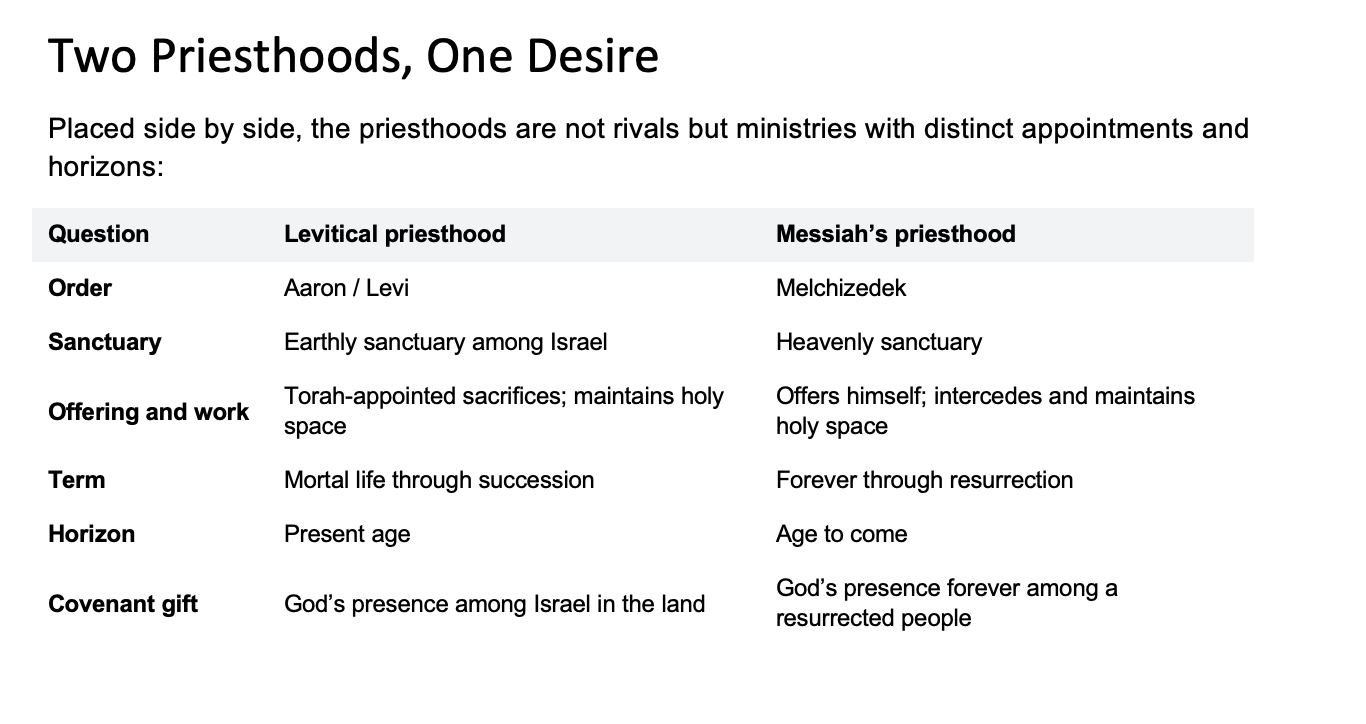
Once we stop forcing both priesthoods into the same sanctuary and same roles, their relationship becomes much easier to see.
A Priesthood That Reaches Beyond Death
Like the Levites, Messiah performs priestly ministry. Unlike the Levites, he does not offer an animal. He offers himself and presents his own blood. He intercedes continually for his people. Revelation even portrays his heavenly ministry with imagery drawn from Israel’s sanctuary: he walks among lampstands, prayers rise like incense, and faithful witnesses wait beneath an altar.
But Messiah’s priesthood is not sustained through a line of successors. Hebrews says he became a priest not on the basis of ancestry but “through the power of an indestructible life” (Hebrews 7:16). Death cannot terminate his office. The risen priest remains forever.
Aaron’s priesthood continues through succession. Messiah’s priesthood continues through resurrection.
That distinction helps us see why his priesthood reaches toward the age to come: the age of resurrection and renewed creation, when heaven and earth are finally united and God dwells with his people forever.
Flesh and blood cannot inherit that kingdom. Mortal, corruptible humanity cannot simply walk into the unveiled presence of God unchanged. If we are going to live with God forever, we are going to need some new hardware!
This is why we need a priesthood whose ministry reaches beyond the conditions of the present age. Messiah has already passed through death and entered resurrection life. He has gone ahead of us into the life of the world to come—not just to show us that such life exists, but to secure our inheritance there.
The Levitical priesthood makes it possible for the holy God to dwell among mortal people in this present creation.
Messiah’s priesthood makes it possible for mortal people to be remade and dwell with God forever.
These priesthoods are not competitors. They belong to different orders, serve in different sanctuaries, accomplish different kinds of purification, and reach toward different covenantal horizons.
Yet both reveal the same extraordinary desire within the heart of God: to dwell with his people.
The Priest Is Alive
God did not stand at a safe distance and tell mortal, sinful humanity to find its own way back to him. He provided the covenant. He provided the sanctuary. He provided the priesthood. He provided the sacrifice. And ultimately, he provided the priest who could carry human life all the way through death and into resurrection.
Every movement toward God begins with something God has already provided.
That means our life with God does not rest upon our ability to hold everything together. Israel could not hold everything together. Her worship has been interrupted. Her sanctuary has been lost. Her people have endured exile, even to this day. But interruption is not abandonment. God remains faithful to his covenant, even through long seasons when we struggle to see how his purposes will continue.
There are seasons when the form of worship we have known changes. Things we believed would remain may not remain. Places, institutions, ministries, relationships, and communities that helped us meet with God can become fragile—or sometimes even disappear. The pain of that experience is real. But our confidence does not rest in our ability to preserve every structure. It rests in the faithfulness of the God who keeps covenant across generations.
The priest is alive.
He has not retired. He has not been replaced. He has not abandoned his post. Wherever the future takes us, we have not been left without access to God.
Shadows of the Things to Come
Hebrews calls the earthly sanctuary, its priesthood, its sacrifices, and its rhythms shadows of heavenly things. Paul uses similar language in Colossians 2 when he brings up Israel’s festivals, new moons, and Sabbaths: “These are a shadow of the things that are to come; and the reality is found in Messiah.”
Notice Paul’s tense. They are shadows of things to come—things still ahead of us, not something already passed. A shadow is precious because it tells us that something real is near.
When we remember Passover, welcome Sabbath, rehearse the holy days, or receive the bread and the cup, we are not reenacting something old. We are allowing God’s promised future to become tangible for a moment in the present. We are practicing, in small and embodied ways, for life in the world to come.
If I told my children, “Shabbat no longer matters. Lighting the menorah at Hanukkah no longer matters. Building the sukkah in the backyard each fall isn’t important,” they would be crushed! They would look at me as though I had stolen Christmas—which, for the record, we also celebrate!
For our family, these practices have become little tastes of home. They allow us to reach backward and remember God’s faithfulness to his people while reaching forward toward everything he has promised. The fullness is not here yet. But the shadow is growing stronger, and the table has already been set.
Bread, Wine, and the Table of Messiah
Long ago, Melchizedek—the king of righteousness, king of peace, and priest of God Most High—came out to meet Abram after a great victory. He set out the bread and the wine.
Many generations later, at the Passover meal before his death, Jesus gathered his disciples around another table. He took bread, blessed God, broke it, and gave it to them. Then he took the cup and said, “This cup is the new covenant in my blood.”
But Jesus also pointed them beyond that room. He said he longed for day when he would drink the fruit of the vine anew in the kingdom. Scripture promises that when he returns to reign in fullness, he will host a huge banquet on a mountain in Jerusalem, where people will come from east and west to take their places at the table with Abraham, Isaac, and Jacob.
The disciples will be there. Moses and Elijah will be there. Miriam and Junia will be there. People from every generation and every nation who have worshiped the God of Israel will gather around that table.
Imagine the stories that will be told! Imagine hearing what God accomplished through lives we never knew and places we never saw. Imagine talking together about all the wonderful things unfolding in a world finally governed by the Messiah!
And then our risen King and eternal high priest will stand. With nail-scarred hands, he will lift the bread, bless God, and break it.
Our high priest is preparing us for that day.
Every time we come to the table, we look in three directions.
We look backward—to the covenant already cut and the offering already made.
We look upward—to the living high priest who now ministers and intercedes for us in the heavenly sanctuary.
And we look forward—to the table of Messiah that is still to come.
The bread and the cup are a taste of a world we cannot yet see. The Table of Messiah is the age to come placed briefly into our hands by our Great High Priest.